Research: Vision-Language Model for Whole Slides
CPath-Omni: A Unified Multimodal Foundation Model for Patch and Whole Slide Image Analysis in Computational Pathology
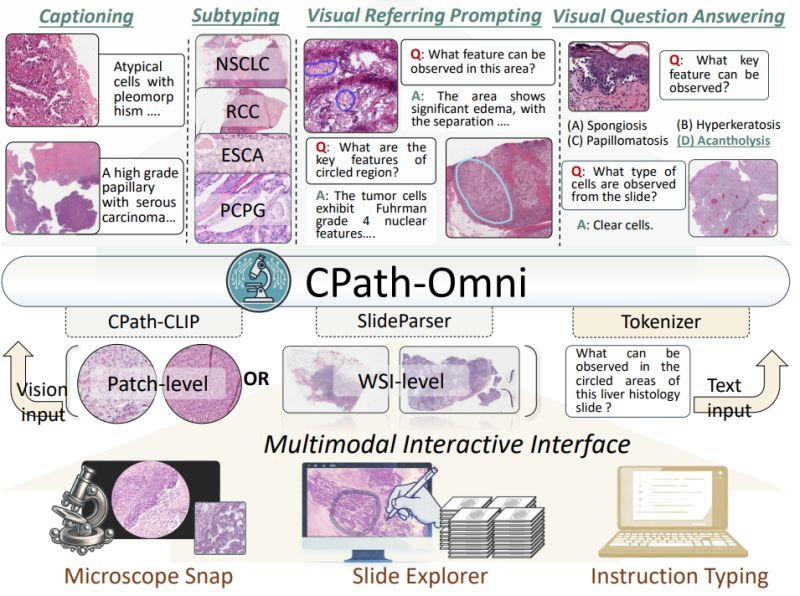
Imagine an AI assistant that can seamlessly analyze everything from individual tissue patches under a microscope to entire gigapixel whole slide images, answering questions like "What key features can be observed in this circled region?" or generating comprehensive pathology reports.
Yuxuan Sun et al. introduced CPath-Omni at CVPR 2025 - the first 15 billion parameter AI model to unify patch-level and whole slide image analysis in computational pathology, bringing us closer to a true "one-for-all" diagnostic assistant.
𝐓𝐡𝐞 𝐟𝐫𝐚𝐠𝐦𝐞𝐧𝐭𝐚𝐭𝐢𝐨𝐧
𝐜𝐡𝐚𝐥𝐥𝐞𝐧𝐠𝐞: Current pathology AI systems are split between patch-level models for detailed tissue analysis and separate whole slide image models for broader diagnostic tasks. This fragmentation leads to redundant development efforts and prevents knowledge transfer between different scales of analysis, limiting the integration of learned patterns across the pathology workflow.
𝐊𝐞𝐲 𝐢𝐧𝐧𝐨𝐯𝐚𝐭𝐢𝐨𝐧𝐬:
∙ 𝐂𝐏𝐚𝐭𝐡-𝐂𝐋𝐈𝐏: Novel pathology CLIP model combining DINOv2-based Virchow2 with traditional CLIP, using a large language model as text encoder for superior alignment
∙ 𝐔𝐧𝐢𝐟𝐢𝐞𝐝
𝐚𝐫𝐜𝐡𝐢𝐭𝐞𝐜𝐭𝐮𝐫𝐞: Single model handling both patch analysis and gigapixel whole slide images up to 100,000 × 100,000 pixels
∙ 𝐅𝐨𝐮𝐫-𝐬𝐭𝐚𝐠𝐞 𝐭𝐫𝐚𝐢𝐧𝐢𝐧𝐠: Progressive learning from patch-based pretraining to mixed patch-WSI training for knowledge transfer
∙ 𝐌𝐮𝐥𝐭𝐢-𝐭𝐚𝐬𝐤 𝐜𝐚𝐩𝐚𝐛𝐢𝐥𝐢𝐭𝐢𝐞𝐬: Classification, visual question answering, captioning, and visual referring prompting across both scales
𝐖𝐡𝐲 𝐭𝐡𝐢𝐬 𝐦𝐚𝐭𝐭𝐞𝐫𝐬: CPath-Omni achieved state-of-the-art performance on 39
out of 42 datasets across seven diverse tasks, even surpassing human pathologist performance on some benchmarks (72.4% vs 71.8% on PathMMU). More importantly, it demonstrates that knowledge learned at the patch level can effectively enhance whole slide image understanding, suggesting a path toward more efficient and comprehensive pathology AI systems.
This unified approach could streamline pathology workflows and make advanced AI diagnostics more accessible in resource-limited clinical settings.
|