Research: Agents for Pathology
PathFinder: A Multi-Modal Multi-Agent System for Medical Diagnostic Decision-Making Applied to Histopathology
Pathologists spend hours navigating gigapixel-scale tissue images, carefully examining suspicious regions and gathering evidence to make critical cancer diagnoses. It's a methodical, iterative process that requires enormous expertise—and it's becoming unsustainable as cancer cases rise globally.
New research by Ghezloo et al. introduces PathFinder, a multi-agent AI system that mimics this exact diagnostic workflow, achieving something remarkable: it's the first AI to outperform average pathologist performance in melanoma classification.
𝐖𝐡𝐲 𝐭𝐡𝐢𝐬 𝐦𝐚𝐭𝐭𝐞𝐫𝐬:
Traditional AI approaches analyze tissue patches independently,
missing the holistic reasoning that makes expert pathologists so effective. They look at pieces but lose the forest for the trees. Real diagnosis requires navigating the image strategically, building evidence, and synthesizing findings—exactly what PathFinder does.
𝐊𝐞𝐲 𝐢𝐧𝐧𝐨𝐯𝐚𝐭𝐢𝐨𝐧𝐬:
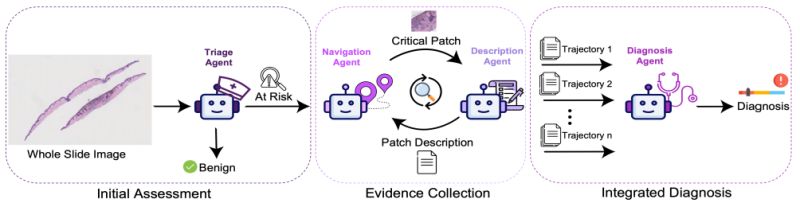
◦ 𝐅𝐨𝐮𝐫-𝐚𝐠𝐞𝐧𝐭 𝐚𝐫𝐜𝐡𝐢𝐭𝐞𝐜𝐭𝐮𝐫𝐞: Triage Agent classifies risk level, Navigation Agent identifies suspicious regions, Description Agent analyzes patches in natural language, and Diagnosis Agent synthesizes final conclusions
◦ 𝐈𝐭𝐞𝐫𝐚𝐭𝐢𝐯𝐞 𝐞𝐯𝐢𝐝𝐞𝐧𝐜𝐞
𝐠𝐚𝐭𝐡𝐞𝐫𝐢𝐧𝐠: Each agent's findings inform the next, creating a feedback loop that refines focus with each examination cycle
◦ 𝐈𝐧𝐭𝐞𝐫𝐩𝐫𝐞𝐭𝐚𝐛𝐥𝐞 𝐫𝐞𝐚𝐬𝐨𝐧𝐢𝐧𝐠: Natural language descriptions of diagnostically relevant patches provide clear explanations for decisions
𝐓𝐡𝐞 𝐫𝐞𝐬𝐮𝐥𝐭𝐬:
PathFinder achieved 74% accuracy on the challenging M-Path melanoma dataset—a 9% improvement over the 65% average human pathologist performance and 8% better than previous state-of-the-art methods. Expert pathologists rated the system's patch descriptions as comparable to GPT-4o quality.
𝐖𝐡𝐲 𝐭𝐡𝐢𝐬
𝐦𝐚𝐭𝐭𝐞𝐫𝐬:
This isn't just about automation—it's about augmenting human expertise in areas where diagnostic accuracy literally saves lives. The multi-agent approach offers something traditional AI lacks: explainable reasoning that pathologists can review, validate, and learn from.
As cancer cases continue rising globally, systems like PathFinder could help democratize access to expert-level diagnostic capabilities while maintaining the interpretability that medical professionals demand.
|