Why models trained at one site often fail everywhere else—and what to do about it
 ‌ ‌ ‌ ‌ ‌ ‌ ‌ ‌ ‌ ‌ ‌ ‌ ‌ ‌ ‌ ‌ ‌ ‌ ‌ ‌ ‌ ‌ ‌ ‌ ‌ ‌ ‌ ‌ ‌ ‌ ‌ ‌ ‌ ‌ ‌ ‌ ‌ ‌ ‌ ‌ ‌ ‌ ‌ ‌ ‌ ‌ ‌ ‌ ‌ ‌ ‌ ‌ ‌ ‌ ‌ ‌ ‌ ‌ ‌ ‌ ‌ ‌ ‌ ‌ ‌ ‌ ‌ ‌ ‌ ‌ ‌ ‌ ‌ ‌ ‌ ‌ ‌ ‌ ‌ ‌ ‌ ‌ ‌ ‌ ‌ ‌ ‌ ‌ ‌ ‌ ‌ ‌ ‌ ‌ ‌ ‌ ‌ ‌ ‌ ‌ ‌ ‌ ‌ ‌ ‌ ‌ ‌ ‌ ‌ ‌ ‌ ‌ ‌ ‌ ‌ ‌ ‌ ‌ ‌ ‌ ‌ ‌ ‌ ‌ ‌ ‌

Site Bias: When Your Model Learns the Environment, Not the Signal


Your model just crushed validation. 94% accuracy, stakeholders thrilled, deployment approved. Then you test it at the partner hospital across town, and performance craters to 63%.


What happened?


Your model wasn't learning cancer. It was learning the stain, the scanner, the tissue prep workflow.

This is site bias—one of the most consistent failure modes in production computer vision. High-performing pilots that collapse the moment the context shifts: new scanners, different labs, next season's crops, another satellite constellation.


The problem isn't malicious or careless. It's structural.


Models Learn What's Easy, Not What You Asked For


AI naturally latches onto the most predictive signals in your data. Unfortunately, those signals are often artifacts rather than biology. If all your training data comes from one site, one scanner, one staining protocol, or one growing season, your model will encode those environmental quirks first. It's called shortcut learning, and it masquerades as accuracy.


In digital pathology, H&E stain variations across labs create systematic differences in color and contrast. Models learn stain style instead of tumor morphology. They perform beautifully on slides from the lab that provided training data, then fail at external sites with different staining workflows. Even within one institution, protocol changes or scanner upgrades cause performance drift.


In Earth observation, models trained on one region often memorize local geography and vegetation patterns—the specific soil reflectance, terrain textures, and plant phenology of their training area—instead of generalizable environmental signals. Deploy them on a different satellite constellation, new atmospheric conditions, or unfamiliar geography, and they break.


In agriculture, crop health models overfit to light angles, time of year, and weather patterns specific to their training region. They learn "the look of July in Iowa" rather than disease signatures. Apply them to new seasons or latitudes, and predictions degrade catastrophically.


The Hidden Costs for Leaders


Site bias creates false confidence. Pilots appear successful until you attempt external validation. Teams confuse performance with generalization because they're validating on the same source. You invest months building something that works beautifully in controlled conditions, then discover it fails the moment it encounters the real world's messy variability.


Time and trust evaporate when cross-site deployment suddenly breaks—though the brittleness was there from day one, hidden by narrow test conditions.


Design for Robustness From the Start


Success depends on generalizing to the right environments, not the ones that are convenient.


Require external validation early, not at the end. Ensure training data spans multiple labs, sensors, seasons, and geographies. Include stress tests: unseen sites, different instruments, new staining workflows, varied weather patterns, alternative scanner models.


Ask your teams three questions:

  • "What biases might our data quietly encode?"

  • "Where do we expect this model to break?"

  • "How do we know it's learning biology, not stain style?"

Foundation models can help—they've seen more visual diversity—but they don't eliminate this risk. They also ingest site-specific style unless curated intentionally across centers. You still need multi-source validation.


Accuracy in One Lab Isn't a Win—It's a Warning Sign


The real metric isn't performance under ideal conditions. It's robustness across contexts: different labs, sensors, seasons, and geographies.


Leaders who insist on cross-site, cross-season, cross-sensor grounding from day one build computer vision that survives deployment. The rest build pilots that shine briefly, then collapse under real-world complexity.


The next generation of impactful AI won't just work in the lab where it was trained. It will hold up everywhere it matters.


If you're wondering whether your project is vulnerable to stain bias, sensor drift, or seasonal shortcuts, let's take 30 minutes to map the risks. A short Pixel Clarity Call can save months of rework and failed validation down the road.


Book Your Pixel Clarity Call Now


- Heather

Vision AI that bridges research and reality

— delivering where it matters


Research: Fine-Tuning Foundation Models


Single GPU Task Adaptation of Pathology Foundation Models for Whole Slide Image Analysis


Pathology foundation models have shown impressive capabilities for analyzing whole slide images, but there's been a persistent problem: adapting these massive pre-trained models for specific clinical tasks typically requires expensive multi-GPU infrastructure, limiting their accessibility for most labs and hospitals.

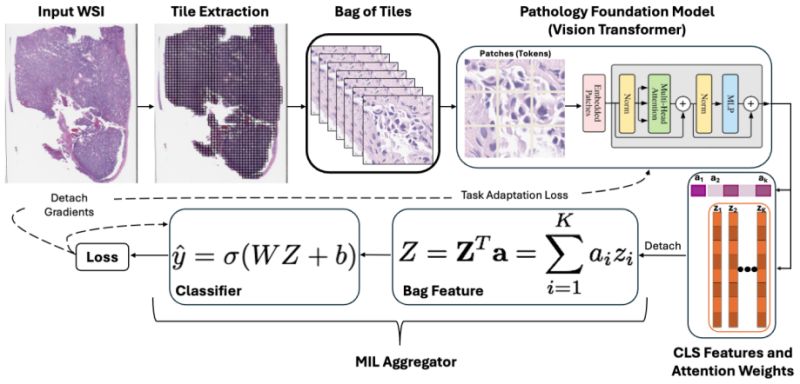
Neeraj Kumar et al. from Memorial Sloan Kettering Cancer Center and Mount Sinai just released work that changes this equation. Their approach, TAPFM (Task Adaptation of Pathology Foundation Models), enables end-to-end fine-tuning of billion-parameter foundation models on a single GPU.

𝐖𝐡𝐲 𝐭𝐡𝐢𝐬 𝐦𝐚𝐭𝐭𝐞𝐫𝐬:
Most current methods treat foundation models as frozen feature extractors, training only separate aggregation layers on top. This limits how well these models can specialize for specific diagnostic tasks like mutation prediction or treatment response estimation.

𝐊𝐞𝐲 𝐢𝐧𝐧𝐨𝐯𝐚𝐭𝐢𝐨𝐧𝐬:
- Leverages the vision transformer's built-in attention mechanism for multiple instance learning aggregation
- Maintains separate computational graphs for the foundation model and aggregator with a dual-loss mechanism
- Addresses gradient instability issues that typically arise when jointly training foundation models and MIL components
- Enables practical fine-tuning on standard hardware (single H100 GPU)

𝐑𝐞𝐬𝐮𝐥𝐭𝐬:
Tested on mutation prediction tasks for bladder cancer and lung adenocarcinoma across multiple cohorts, TAPFM with H-Optimus-0 consistently outperformed conventional fixed-feature approaches. The method also handles multi-label classification of actionable mutations effectively.
This could meaningfully lower the barrier for hospitals and research institutions to adapt powerful pathology AI models for their specific clinical needs.

Insights: Multimodal Earth Observation


Pixels Aren’t Enough – The Case for Truly Multimodal EO Models


Satellite imagery shows us the surface. But if we want to understand why something is happening—or predict what’s next—we need more than pixels.

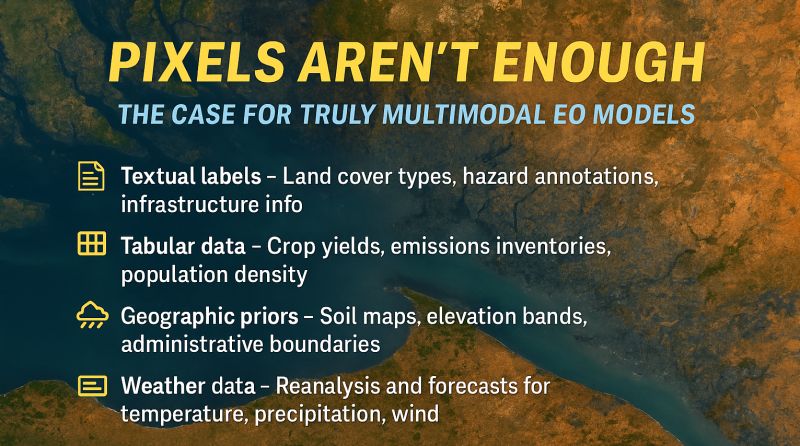
What multimodal models add beyond imagery:
🗂️ Textual labels – land cover types, hazard annotations, infrastructure info
📊 Tabular data – crop yields, emissions inventories, population density
🗺️ Geographic priors – soil maps, elevation bands, administrative boundaries
🌦️ Weather data – reanalysis and forecasts for temperature, precipitation, wind

Each of these brings context that satellite imagery alone can’t provide. They anchor image patterns in meaning—physical, social, and policy-relevant.

For instance, combining imagery with crop yield stats and precipitation data can help assess food security more accurately than pixels alone.

🧭 Why this matters:
- Enables semantic alignment—connecting image patterns to real-world categories
- Supports advanced tasks like language-based retrieval, scenario analysis, or causal inference
- Powers vision-language models that respond to prompts like “find expanding agricultural zones near wetlands”
- Enables EO agents—models that combine perception, reasoning, and retrieval to assist analysts like intelligent copilots
- Improves interpretability, especially in decision-making contexts (e.g., urban planning, disaster response)

⚠️ Design challenges to watch out for:
- Misalignment in scale or timing across modalities
- Models learning to cheat with metadata (e.g., associating labels with regions)
- Loss of transparency when multiple data sources are stacked blindly

But adding more data isn’t always better—it depends on what the model is learning, and why.

📌 Multimodal EO models bring us closer to real-world insight—but only when the added signals are relevant to the task, aligned in time and space, and tied to the real-world outcomes we care about.

👇 Have you tried adding tabular, textual, or weather data to your EO models?
What did it unlock—or complicate?

Leave a comment

Research: Vision-Language for Agriculture


AgroGPT: Efficient Agricultural Vision-Language Model with Expert Tuning


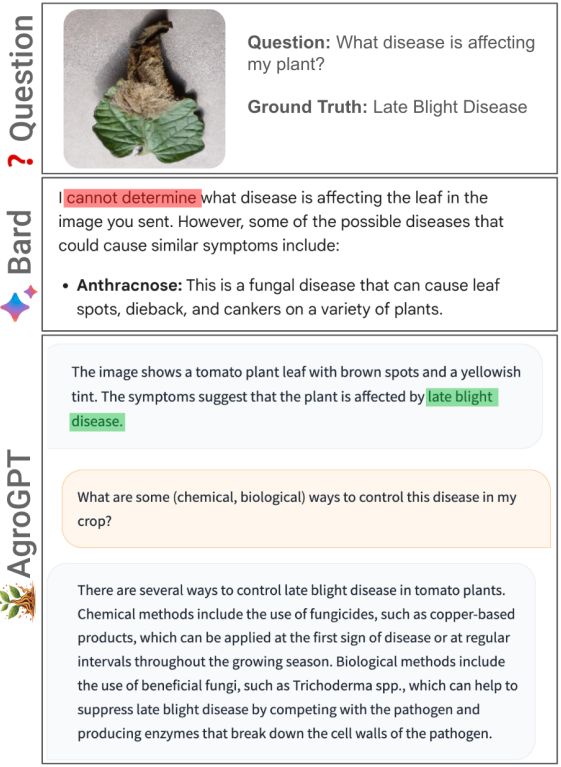
Large multimodal models like GPT-4V and LLaVA excel at visual conversation—but they struggle in specialized domains like agriculture, often hallucinating or providing incorrect information. The standard solution is instruction-tuning with domain-specific image-text pairs. But what if that data doesn't exist?

Muhammad Awais et al. developed AgroGPT, demonstrating how to build effective agricultural vision-language models using only vision datasets.

𝐓𝐡𝐞 𝐜𝐡𝐚𝐥𝐥𝐞𝐧𝐠𝐞:
Fields like biomedicine have large vision-language datasets that enable domain-specific instruction tuning. Agriculture has abundant vision-only classification datasets (plant diseases, weeds, insects, fruits) but lacks the paired image-text conversational data needed for instruction tuning.

𝐓𝐡𝐞 𝐚𝐩𝐩𝐫𝐨𝐚𝐜𝐡:
The authors created AgroInstruct, a 70K expert-tuning dataset synthesized entirely from vision-only data:
- Generated context-grounded image descriptions using general-purpose multimodal models
- Extracted image attributes from classification labels
- Gathered class-specific background knowledge from agricultural resources
- Used LLMs to synthesize complex multi-turn conversations combining descriptions, attributes, and domain knowledge

They used three types of instruction data:
- 10K rich image descriptions
- 35K simple questions (identification tasks)
- 35K complex multi-turn conversations

𝐓𝐡𝐞 𝐭𝐫𝐚𝐢𝐧𝐢𝐧𝐠 𝐬𝐭𝐫𝐚𝐭𝐞𝐠𝐲:
Three-stage process: (1) vision-language concept alignment on general images, (2) general instruction tuning, (3) expert tuning on AgroInstruct with a frozen visual encoder. Models were trained with 3B and 7B parameters.

𝐊𝐞𝐲 𝐫𝐞𝐬𝐮𝐥𝐭𝐬:
- AgroGPT significantly outperforms ChatGPT and Bard on fine-grained agricultural concept identification
- Excels at complex, multi-turn domain-specific conversations
- Competitive with general models on general questions while providing superior agricultural expertise
- Demonstrates that synthetic instruction data from vision-only datasets can effectively bridge the domain gap

𝐖𝐡𝐲 𝐭𝐡𝐢𝐬 𝐦𝐚𝐭𝐭𝐞𝐫𝐬:
This work provides a blueprint for domains lacking paired vision-language data. The pipeline shows how to leverage existing classification datasets, external knowledge bases, and LLMs to synthesize high-quality instruction-tuning data—making specialized multimodal AI accessible to domains beyond those with large-scale paired datasets.

Insights: Model Usability


Beautiful Theory, Brutal Budget


A model that wins on paper might lose in the clinic—because beauty doesn’t equal usability.

𝐓𝐡𝐞𝐨𝐫𝐞𝐭𝐢𝐜𝐚𝐥 𝐁𝐫𝐢𝐥𝐥𝐢𝐚𝐧𝐜𝐞 ≠ 𝐂𝐥𝐢𝐧𝐢𝐜𝐚𝐥 𝐅𝐞𝐚𝐬𝐢𝐛𝐢𝐥𝐢𝐭𝐲

The model that dazzles on benchmarks might buckle under real-world constraints.
State-of-the-art architectures often optimize for AUROC—not inference time, memory usage, or cost.

But in the clinic, every second, every dollar, and every GPU cycle matters.

Hospitals and labs don’t run like tech companies. They have:
- Limited compute infrastructure
- Strict latency requirements
- Energy and budget constraints

📍 Example: A pathology model with multiscale ViT backbones and attention across 100,000 patches might be elegant—but if it takes 8 GPUs and 5 minutes per slide, it’s a non-starter in a high-volume lab.
Clinicians won’t wait for your model to finish its beautiful math. And if it takes 5 minutes per slide, that’s hours of delay across a lab processing 1,000 slides a day—delaying diagnoses, not accelerating them.

𝐅𝐞𝐚𝐬𝐢𝐛𝐢𝐥𝐢𝐭𝐲 𝐢𝐬 𝐚 𝐜𝐥𝐢𝐧𝐢𝐜𝐚𝐥 𝐫𝐞𝐪𝐮𝐢𝐫𝐞𝐦𝐞𝐧𝐭.
Models must not only perform—but also scale.

𝐒𝐨 𝐰𝐡𝐚𝐭?
If your model can’t run where decisions are made, it won’t help patients.
The impact—and investment—evaporate.

💬 How do you balance model sophistication with deployment constraints?

Leave a comment