Image Analysis with Deep Learning to Predict Breast Cancer Subtypes
Project Details
Background: Molecular tests are widely used for patients with some types of breast cancers; however, they can be costly and are not available in many countries. Methods for inferring molecular subtype from histologic images may identify patients most likely to benefit from further genomic testing.
Challenge: Some tumor properties like grade are assigned by a pathologist from histology. Others are computed from molecular properties and were not previously known to be predictable from images. Our methods were the first to test whether estrogen receptor status and genomic subtype can be predicted from H&E histology.
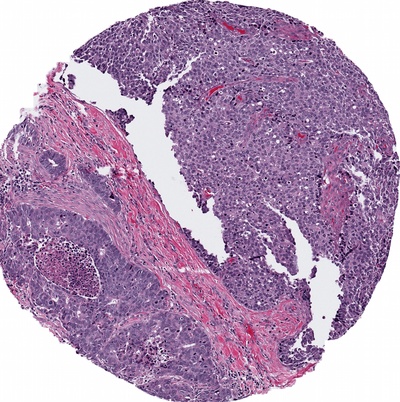
Solution: We developed an image analysis approach using deep transfer learning. A training set of breast tumors was used to create image-based classifiers for tumor grade, ER status, PAM50 intrinsic subtype, histologic subtype, and risk of recurrence score. The resulting classifiers were then applied to an independent test set.
Results: Histologic image analysis with deep learning distinguished each of these classes with high accuracy. Our method was the first to demonstrate that molecular and genomic properties of breast tumors can be predicted from H&E histology. We also demonstrated a visualization technique to show which parts of the tumor are associated with each class.
Additional Applications: Given sufficient labeled data, computers can learn concepts much more complex than even the best trained human experts. While molecular subtypes of breast cancer is one example, machine learning, and deep learning in particular, can provide suitable methods for many complex tasks from assessing prognosis of cancer to predicting earthquake aftershocks. The key is a sufficiently large set of labeled data - the more the better.